What is QEEG?
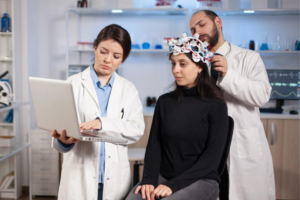
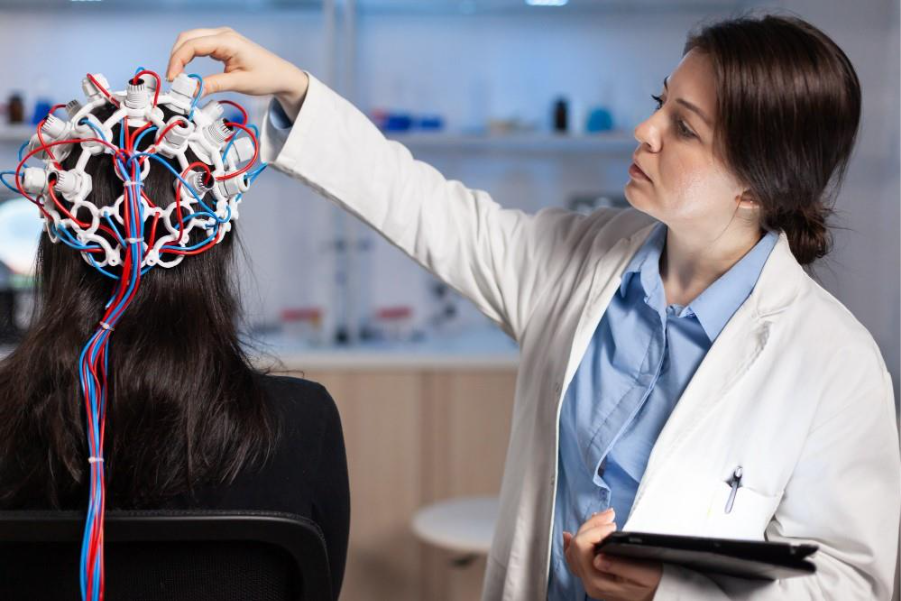
QEEG stands for quantitative electroencephalogram. It is a safe and non-invasive test that measures brain activity. Unlike a regular EEG, QEEG uses advanced computer technology to analyze brain waves in detail. This process creates a brain map that shows how different areas of the brain function. Many experts refer to this as “brain mapping for mental health.” QEEG is gaining popularity as a valuable tool for both mental fitness and neurorehabilitation.
How QEEG Works
During a QEEG test, small sensors are placed on your scalp to record the electrical signals from your brain. A computer then analyzes these signals, creating a brain map that reveals patterns related to mood, focus, and memory. Because the test is painless and quick, many people find it easy to complete.
- Small sensors are placed on the head
- Brain waves are recorded for about 20-30 minutes
- Data is analyzed by computer software
- Doctors review the brain map for patterns
Benefits of QEEG in Mental Fitness
QEEG offers numerous benefits for mental fitness. It helps doctors spot areas of the brain that may require support, and can guide personalized plans for mental health. Many people use QEEG to enhance focus, reduce stress, or improve memory. Furthermore, it can track progress over time.
- Identifies brain patterns linked to mood or attention
- Helps create custom mental fitness plans
- Monitors changes after therapy or training
- Supports early detection of mental health issues
QEEG in Neurorehabilitation
QEEG is also a valuable tool in neurorehabilitation, helping individuals recover from brain injuries or illnesses. For example, QEEG can highlight which brain areas are weak or overactive, allowing doctors to design better therapy plans. Research in peer-reviewed journals shows that QEEG-guided therapy can speed up recovery for some patients.
- Guides therapy after stroke or brain injury
- Tracks progress during neurorehabilitation
- Helps adjust treatment for better results
- Supports recovery in both children and adults
Who Can Benefit from QEEG?
Many individuals can benefit from QEEG, including those with attention issues, anxiety, or depression. It is also helpful for people recovering from brain injuries. In the USA and around the world, QEEG is used for:
- Children with learning or behavior issues
- Adults with memory or mood problems
- People recovering from stroke or trauma
- Anyone looking to improve mental fitness
Safety and Limitations
QEEG is very safe. It doesn’t use radiation or cause pain. However, it’s essential to understand its limitations. QEEG is not a diagnostic tool on its own but provides additional information to assist doctors. The results depend on the expertise of the professional conducting the test. Always seek a trained specialist for QEEG brain mapping.
Future Prospects of QEEG
As technology advances, QEEG will become even more accurate and precise. In the future, it may help identify mental health risks earlier. New research may lead to better treatments based on QEEG brain maps. Experts from the World Health Organization and leading medical journals see great potential for QEEG in the field of mental health.
Conclusion & Next Steps
- QEEG, or quantitative EEG, is a powerful and non-invasive tool for mental fitness and neurorehabilitation. It provides detailed brain mapping for mental health, offering insights into mood, memory, and brain function. If you want to explore whether QEEG is right for you, consult a neurology specialist. They can guide you on the next steps for optimizing your brain health.
References
- Coben, R., & Chabot, R. (2007). Quantitative EEG in the evaluation and treatment of ADHD: An overview. Applied Neuropsychology, 14(2), 67–76. https://doi.org/10.1207/s15324826an1402_1
- Centers for Disease Control and Prevention (CDC). (2024, May 15). About epilepsy and seizures. https://www.cdc.gov/epilepsy/about/index.html
- World Health Organization (WHO). (2018). Mental health: Strengthening our response. Retrieved January 9, 2026, from https://www.who.int/news-room/fact-sheets/detail/mental-health-strengthening-our-response